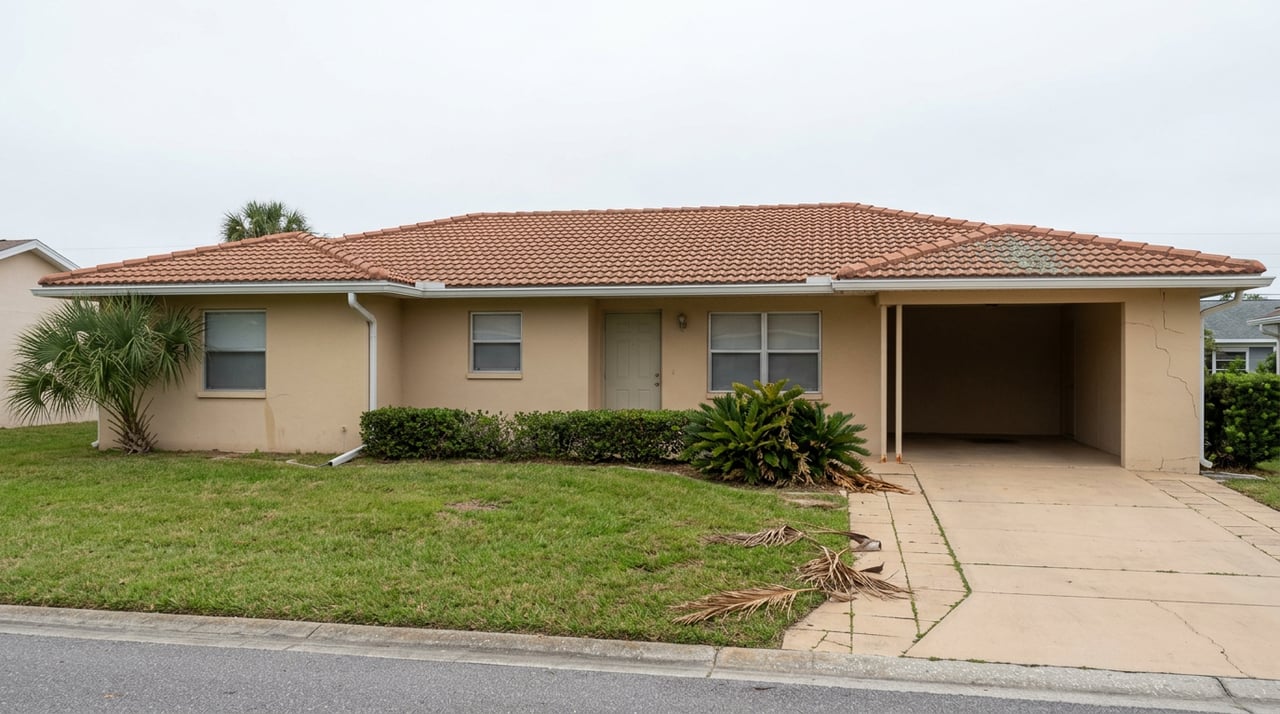
In Seminole, the Listing Photo Can't Tell You If a VA Loan Is Even Possible
September 24, 2026
September 24, 2026
A veteran stationed nearby calls a lender about a 55-plus community in Seminole. The listing shows a fishing pier, a shuffleboard court, a monthly fee under $300, and the words "resident-owned" right in the description. It reads like the safest kind of purchase a first-time manufactured-home buyer could make. The lender asks one question before anything about credit or income comes up: who holds the deed to the lot. The answer kills the loan before the conversation gets anywhere near underwriting.
That call happens often enough in Seminole's manufactured-home market that it deserves its own explanation, because the reason has nothing to do with the buyer and everything to do with how the land under these homes is actually held. Seminole's stock of manufactured and mobile homes splits into three ownership structures that look nearly identical in a portal listing and behave completely differently under VA rules. Only one of them can produce a VA loan.
A VA loan is a real estate loan. The government guarantee attaches to land and the permanent structure on it, financed and titled together as one piece of real property. If a veteran owns the home but rents the ground it sits on, the VA treats that home as personal property, the same legal category as a car or a boat. No amount of income, credit score, or entitlement changes that classification. The land question comes first, and it comes before the appraisal, before the inspection, before anything a buyer normally worries about.
Seminole's park stock breaks into three categories that a listing description will rarely spell out in plain terms:
| Ownership structure | What it means | VA outcome |
|---|---|---|
| Land-lease / lot rent | Buyer owns the home, pays monthly rent to a park owner for the ground | Not eligible. Classified as personal property. |
| Resident-owned cooperative or share | Buyer owns a share in the corporation that owns the park, not a deed to a specific lot | Generally not eligible. Cooperative structures don't meet the real-property test. |
| Deeded lot | Buyer receives an actual deed to the specific parcel the home sits on | Can be eligible, if the home also clears the age and foundation tests below |
A park like the one marketed today as Pine Acres on Seminole Boulevard illustrates the first category well. Homes there are sold through the community's own sales office, with financing arranged in-house, the kind of arrangement that signals lot-rent economics even when the listing itself never uses that phrase. That same address carries a separate state manufactured-home license under the name Bickley Park, a detail that only shows up if you check Florida's licensing records rather than the marketing copy, and a reminder that the name on the sign and the name on the title paperwork aren't always the same thing.
This is the part that catches people off guard. Communities like Lake Seminole Estates and Holiday Village both describe themselves as resident-owned or share-park communities, language that sounds like ownership in the way a veteran expects it to work. It isn't. A cooperative share gives a buyer an ownership interest in the corporation that owns the entire park, along with the right to occupy a specific lot. It does not give the buyer a deed to that lot. VA underwriting guidance treats cooperative ownership as fundamentally different from fee-simple real estate, and lenders generally cannot make the collateral work because there's no individual parcel for the government to guarantee against.
Holiday Village allows residents of any age, permits up to two dogs under 60 pounds each, and sits close enough to the water to advertise Pinellas Trail views in its listings. Lake Seminole Estates markets itself as a 55-plus waterfront share community with the same appeal. Both are attractive places to live. Neither one is likely to close with a VA loan, and a veteran who assumes "resident-owned" is a synonym for "you'll own it" is going to lose time finding that out during underwriting instead of during the search.
Land tenure isn't the only filter. Federal law drew a hard line on June 15, 1976, the date the HUD Code took effect for manufactured housing construction and safety standards. A home built before that date has no HUD certification label, cannot be verified against the federal standard, and is permanently ineligible for VA financing regardless of condition, renovation history, or how well it has been maintained.
This matters in Seminole specifically because several homes actively marketed in the city right now predate that cutoff by a wide margin. Listings at Pine Acres have included a 1961 model, a 1968 model, and a 1973 model, all currently changing hands through the park's own sales office. A buyer could solve the land-ownership problem entirely, find a deeded lot, and still be blocked from VA financing simply because the specific home they want was built before the code existed. The age question and the land question are separate gates, and both have to clear before a lender will even start the file.
For a manufactured home to qualify, a lender needs to see more than a deed. The home has to be permanently affixed to a foundation that meets HUD's Permanent Foundations Guide, with wheels, axles, and the towing hitch removed. A licensed engineer typically certifies that the foundation meets load and anchoring requirements, an inspection that runs a few hundred dollars and is usually scheduled around the appraisal. The county has to record the home and land together as a single piece of real estate, taxed as real property rather than through a separate personal-property or DMV-style filing. If any older paperwork still shows the home under a vehicle-style title, that has to be corrected through the county before closing, a process sometimes called title elimination.
None of this is unusual for manufactured housing anywhere in Florida. What makes it worth checking early in Seminole is how much of the current inventory sits in categories, lot rent and cooperative share, where this conversion was never done and likely never will be, because the land itself was never sold to the resident in the first place.
A veteran set on a specific park that turns out to be land-lease or cooperative still has options, just not a VA loan for that particular home. A chattel loan finances the structure alone, typically at a shorter term and higher rate than a VA mortgage. FHA's Title I program offers another path for manufactured homes on leased land, with a maximum loan amount capped at $69,678 for the home itself. Neither replaces the terms a VA loan offers, but both are workable if the community itself, not the buyer, is what disqualifies the file.
The cleaner path, when VA financing matters, is to look specifically for deeded-lot listings from the start. Some do exist in Seminole's market, occasionally advertised in plain language as homes where the buyer owns the land outright with a modest monthly association fee rather than lot rent. Those are the listings worth calling a lender about first.
Before touring anything, a few questions save weeks of wasted effort:
A five-minute phone call answering these before an offer goes in costs nothing. Finding out the answer during underwriting costs an appraisal fee, an inspection fee, and a contract that has to be unwound.
Can I get a VA loan on a home in a Seminole 55-plus community that describes itself as resident-owned? Almost always no. Cooperative and share-park ownership structures don't meet the VA's real-property requirement, even though the marketing language sounds like ownership.
What if the home was built before 1976 but has been completely renovated? Renovation doesn't change the build date. A home built before June 15, 1976 has no path to VA eligibility under any circumstances.
Are single-wide homes ever VA-eligible? Yes, if they meet the same land-ownership, foundation, and HUD-code requirements as any other manufactured home, though many lenders apply their own stricter overlays on single-wides regardless of what the VA technically allows.
Are any parks near Seminole worth checking for deeded-lot ownership? It varies listing to listing rather than park to park in most cases, which is exactly why the land question has to be asked before touring, not after.
Seminole's manufactured-home market has real appeal for a veteran who wants water access, a slower pace, and proximity to Walsingham Park's trails without a coastal price tag. The catch is that the appeal and the eligibility are two separate questions, and only one of them shows up in the listing photos. If you're weighing a manufactured home purchase here and want someone to help sort out which communities are worth a serious look before you spend money on inspections, Christina Colon has spent years working through exactly this kind of property with veteran and investor buyers across Tampa Bay. Let's Connect.
Stay up to date on the latest real estate trends.
Bringing an investor’s mindset, military discipline, and years of Tampa Bay market knowledge to help clients navigate every step of their real estate journey with confidence.
Luxury Presence
[email protected]
(727) 463-0125
License #SL3558237
1400 S International Pkwy Ste 1020 Lake Mary, FL 32746