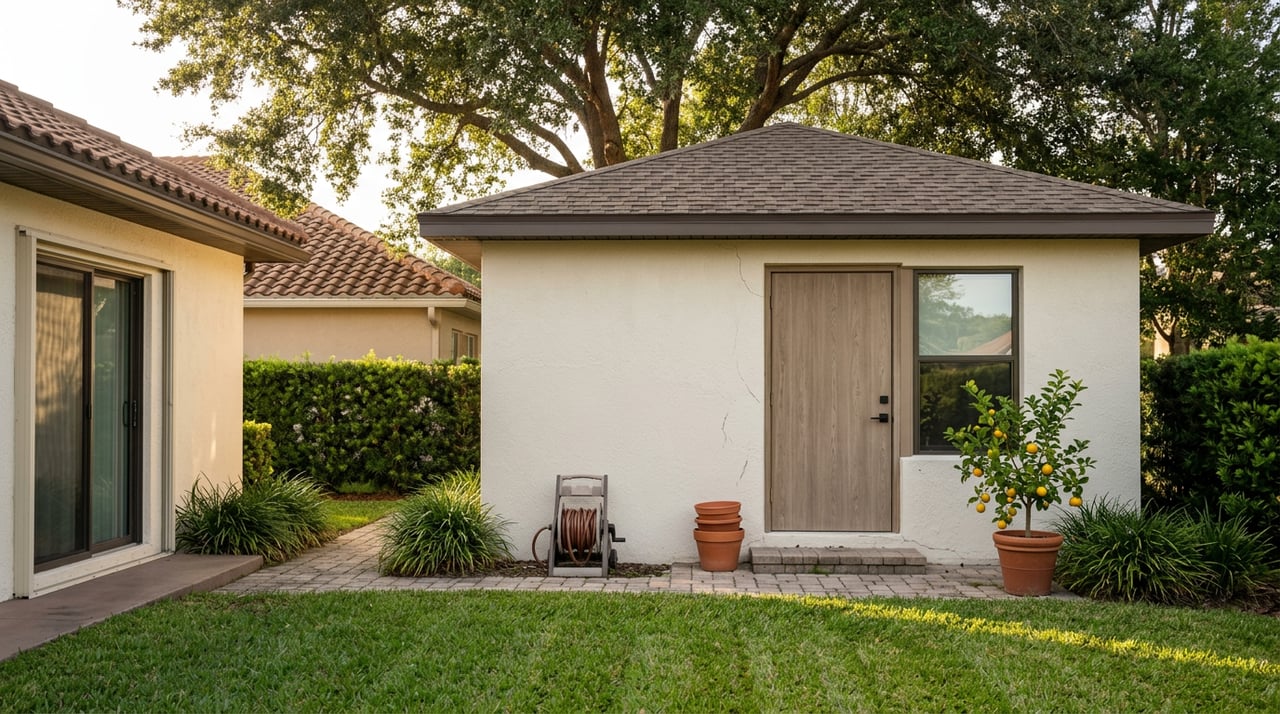
Tampa Accessory Dwelling Unit Rules in 2026, Explained
August 27, 2026
August 27, 2026
An investor pulls up a bungalow in South Tampa, runs the numbers on adding a backyard rental unit, and feels good about it. A dozen contractor blogs and finance sites told her that Florida passed a law this year requiring every city to allow an accessory dwelling unit on every single-family lot. She calls Tampa's Development Coordination office to confirm the permit path. The answer she gets back does not match anything she read.
That gap between what the internet says and what Tampa's code actually allows is costing buyers real time and, in some cases, real money. Here is what is actually true as of August 2026, and why it matters if you are looking at a Tampa property with rental income in mind.
Search "Florida ADU law 2026" and you will find confident references to a bill, sometimes called SB 943 or SB 184, that supposedly forces every Florida city and county to permit at least one accessory dwelling unit on every single-family lot. Several ADU cost calculators and builder sites repeat this as settled fact.
It isn't. The actual bill aimed at a statewide ADU mandate is Senate Bill 48, and it has not become law. SB 48 passed the Florida Senate by a 38-0 vote, then stalled in the House in March 2026 over a dispute related to short-term rentals, according to permit-data firm Shovels' review of the bill's progress. Housing advocates expect it to come back in the 2027 session, but until it passes, there is no state requirement forcing Tampa or any other Florida municipality to allow ADUs on every residential lot.
What people are actually citing, whether they realize it or not, is Tampa's own local zoning reform from October 2024. That ordinance is real. It just does not do what the internet claims.
Under the City of Tampa's current code, a standard accessory dwelling unit, meaning a fully independent unit with its own kitchen, bathroom, and sleeping area that can be rented to anyone, is only permitted in four specific parts of the city: Seminole Heights, the area around Lowry Park, the East Tampa Overlay, and the Tampa Heights Overlay. Each has its own standards. Tampa Heights allows units up to 1,100 square feet, while most other eligible zones cap at 950 square feet.
Outside those four areas, a homeowner can still add a secondary unit, but it has to be built as an Extended Family Residence instead. An EFR looks similar on paper but comes with a hard restriction: it can only house a family member, and it cannot legally be rented to an outside tenant. That single distinction is where most of the online confusion collapses.
| Standard ADU | Extended Family Residence (EFR) | |
|---|---|---|
| Where it's allowed | Seminole Heights, the Lowry Park area, the East Tampa Overlay, the Tampa Heights Overlay | Anywhere in the city zoned single-family |
| Maximum size | 950 sq ft (up to 1,100 sq ft in Tampa Heights) | 600 sq ft |
| Can you rent it to a non-family tenant | Yes | No |
| Owner-occupancy of the main house | Required | Required |
If you're evaluating a listing for its rental-unit potential and the address isn't inside one of those four named areas, you are looking at family housing, not income property, unless the rules change again. Eligibility for a standard ADU is also determined parcel by parcel rather than by neighborhood name recognition, which means two houses a few blocks apart can land on opposite sides of this line. Confirming a specific address through the city's Development Coordination staff before writing an offer is the only way to know for certain.
Even inside one of the four eligible zones, Tampa's current rule requires the primary home on the lot to be owner-occupied. That means a pure absentee investor cannot buy a single-family house, add a rentable ADU, and lease out both units with no one living there. This owner-occupancy requirement has been under City Council review, with some council members pushing to relax or eliminate it as part of broader housing supply efforts, but as of now it stands. If your investment plan depends on renting out both structures with no personal residency involved, confirm the current status of that rule before you close, because a change here would meaningfully expand what's possible on paper today.
Building a detached ADU in Tampa typically runs $150 to $250 per square foot depending on finishes and utility connections, which puts a 750-square-foot unit somewhere between $112,000 and $187,000 all in, including permits and landscaping. That is the ADU category, not an EFR, though similar construction costs apply either way since the code requirements for kitchens, plumbing, and structural work are comparable.
Plan on three to six months from application to an approved permit, running through Tampa's Construction Services Center. The timeline depends heavily on plan review backlog and project complexity, so it is worth building that runway into your financing plan rather than assuming a fast turnaround.
Here is the detail that catches even prepared investors off guard. If you build an ADU and the Hillsborough County Property Appraiser's Office determines it is being used as a rental, that unit gets assessed separately as a non-homestead property. That means it does not qualify for Florida's 3% Save Our Homes cap on annual assessment increases, the same cap that protects the rest of your homesteaded property from rapid tax growth. Renting the unit is exactly what makes the ADU pencil as an investment, and it is also exactly what removes it from the tax protection that keeps your overall bill predictable. Both facts are true at once, and most cost calculators online only mention one of them.
The City of Tampa's own case study, released this month, gives a useful picture of what these projects actually look like on the ground. A Sulphur Springs homeowner named Hope Kiriisa is nearing completion of an approximately 400-square-foot unit on her property. Her reasoning captures why these projects appeal to so many owners at once: she wants the option to house aging parents down the road, but she also wants the flexibility to use the space as a home office, a rec room, or a rental if her needs change. Since the city's 2024 rule changes took effect, 28 homeowners have initiated the ADU process citywide, and seven have completed construction, according to the City of Tampa. Hillsborough County as a whole added 363 ADU addresses between 2021 and 2025, with the city of Tampa itself contributing 104 of those, bringing the broader Tampa metro total to nearly 470 over that five-year stretch.
Those numbers tell you two things. ADU activity in Tampa is real and growing, and it is still a small, closely tracked category rather than the wide-open building boom that some online guides imply.
If part of your Tampa search involves adding a backyard unit for rental income, the neighborhood matters more than almost anything else in your search criteria. A house in Seminole Heights or Tampa Heights can plausibly support a legal, rentable ADU. The same square footage in most other parts of the city can only support a family-only EFR, no matter what a listing description or a national cost calculator implies. And if SB 48 does return and pass in the 2027 legislative session, this map could shift again, which is one more reason to verify current status at the parcel level rather than relying on anything written before your closing date.
Is there a Florida law right now requiring every city to allow rentable ADUs? No. Senate Bill 48 would do this, but it stalled in the Florida House in March 2026 and is expected to return in the 2027 session. Until then, each city sets its own rules.
Can I rent out an ADU anywhere in Tampa? Only in four specific areas: Seminole Heights, the Lowry Park area, the East Tampa Overlay, and the Tampa Heights Overlay. Everywhere else, a secondary unit has to be built as a family-only Extended Family Residence.
Does adding an ADU affect my property taxes even if I don't rent it? If the unit is not used as a rental, it stays within your existing homestead assessment. Renting it out triggers a separate non-homestead assessment for that portion of the property, which loses the Save Our Homes cap.
If you are weighing a Tampa purchase with a backyard rental unit in mind, or trying to figure out whether a specific address falls inside one of those four eligible zones, Christina Colon can help you check the parcel-level details before you write an offer. Let's Connect.
Stay up to date on the latest real estate trends.
Bringing an investor’s mindset, military discipline, and years of Tampa Bay market knowledge to help clients navigate every step of their real estate journey with confidence.
Luxury Presence
[email protected]
(727) 463-0125
License #SL3558237
1400 S International Pkwy Ste 1020 Lake Mary, FL 32746